Why use Netflix Eureka in Microservices
Problem
In a microservices architecture, services need to communicate with each other.
A naive approach is to hardcode URLs:
http://localhost:8081\
http://192.168.1.10:8082
This quickly breaks when: - Services scale (multiple instances) - IPs or ports change - Services restart or move - Different environments are used (dev, test, prod)
What Eureka Solves
Netflix Eureka is a service registry that allows services to dynamically discover each other.
Instead of using fixed addresses, services use logical names.
How It Works
- Each service registers itself in Eureka
- Eureka keeps a list of available instances
- Other services query Eureka to find where to send requests
Example:
USER-SERVICE → [10.0.0.1:8080, 10.0.0.2:8080]
ORDER-SERVICE → [10.0.0.3:9090]
Benefits
- Dynamic service discovery
- Loose coupling
- Load balancing support
- Fault tolerance
- Easier scaling
Summary
Eureka removes the need for hardcoded service locations and replaces them with dynamic discovery using service names.
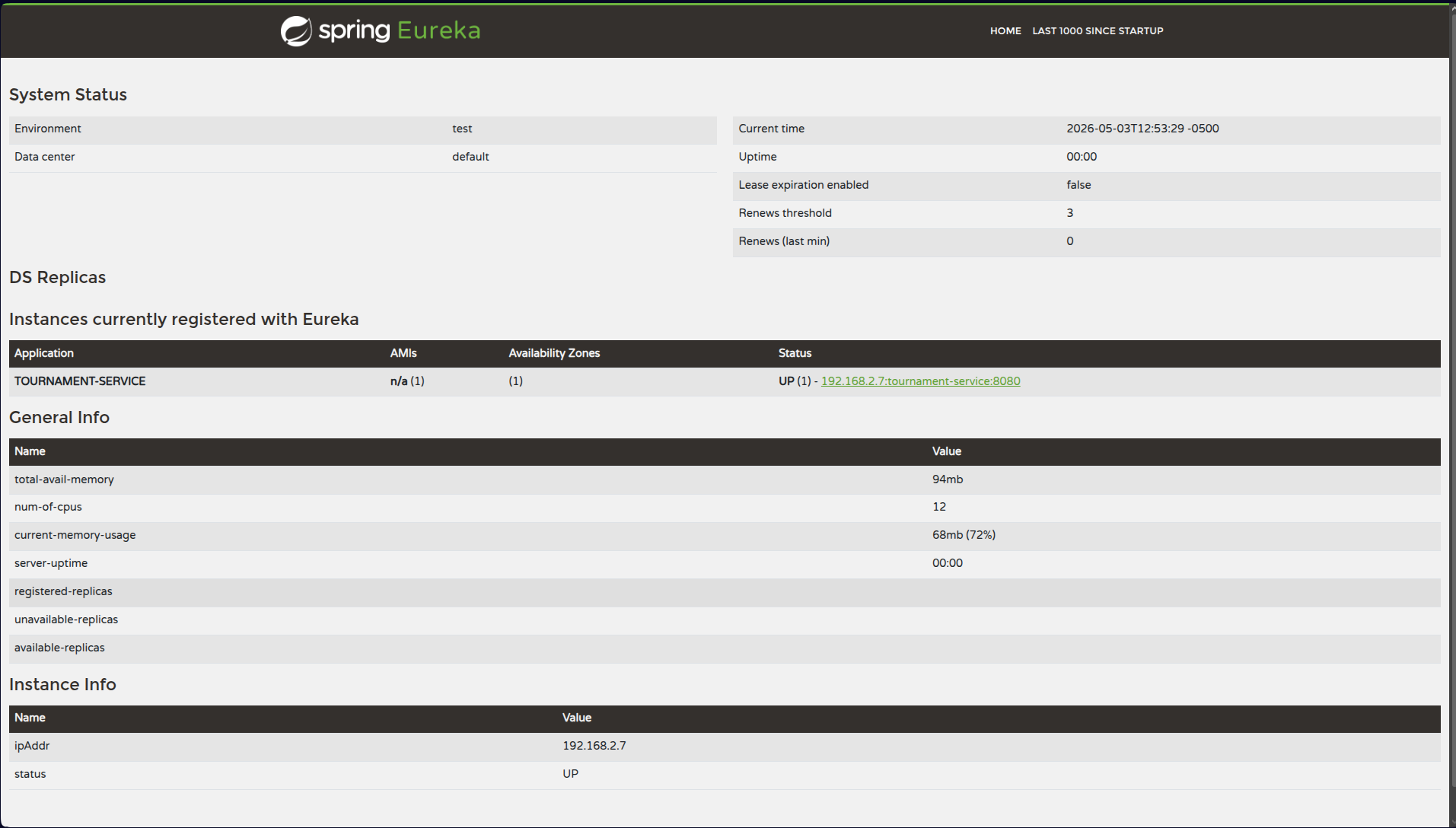
This is an example on how eureka is recognizing tournament-service micro service at port 8080. Here
we can see what services are active and running and how many instances of them there are.
Hopefully, when we get the Azure thing working, all microservices will be connected here so we can track them :)