This section explains how the Tournament Service was built and how it fits into the TechCup platform architecture.
Tournament Service
Dependencies
Parent
- spring-boot-starter-parent – Base Spring Boot POM (v3.4.1). Manages dependency versions and build defaults.
Runtime dependencies
- spring-boot-starter-web – Enables REST APIs via Spring MVC with an embedded Tomcat server.
- spring-boot-starter-data-jpa – Maps Java entities to database tables and provides repository interfaces for CRUD operations.
- spring-boot-starter-validation – Enables bean validation (
@Valid,@NotBlank,@Future, etc.) on request bodies. - postgresql – JDBC driver that connects the service to its own PostgreSQL database at runtime.
- spring-cloud-starter-openfeign – Lets you call other microservices using a simple annotated Java interface instead of manual HTTP calls. Used to communicate with the Teams Service and the Identity Service.
- spring-boot-starter-actuator – Exposes
/actuator/healthand/actuator/metricsendpoints for monitoring. - mapstruct (v1.6.3) – Generates type-safe mappers between entities and DTOs at compile time.
- lombok – Generates boilerplate code (getters, setters, constructors) from annotations at compile time.
- spring-boot-devtools – Enables automatic restarts during development.
- springdoc-openapi-starter-webmvc-ui (v2.8.0) – Generates and serves a Swagger UI at
/swagger-ui/index.html. - jjwt-api / jjwt-impl / jjwt-jackson (v0.12.6) – JJWT library for reading and validating JWT tokens forwarded by the gateway.
Test dependencies
- spring-boot-starter-test – Provides JUnit 5, Mockito, and AssertJ for unit and integration testing.
- testcontainers:postgresql (v1.20.4) – Spins up a real PostgreSQL instance during integration tests.
- testcontainers:junit-jupiter (v1.20.4) – JUnit 5 integration for Testcontainers lifecycle management.
- h2 – In-memory database used as a lightweight alternative during unit tests.
Build plugins
- spring-boot-maven-plugin – Packages the service as a runnable fat JAR (
java -jar tournament-service.jar). - maven-compiler-plugin – Configured with annotation processor paths for Lombok and MapStruct to ensure correct code generation order.
Dependency management
- spring-cloud-dependencies BOM (v2024.0.0) – Ensures all Spring Cloud libraries (Feign, etc.) use compatible versions together.
Diagrams & JPA
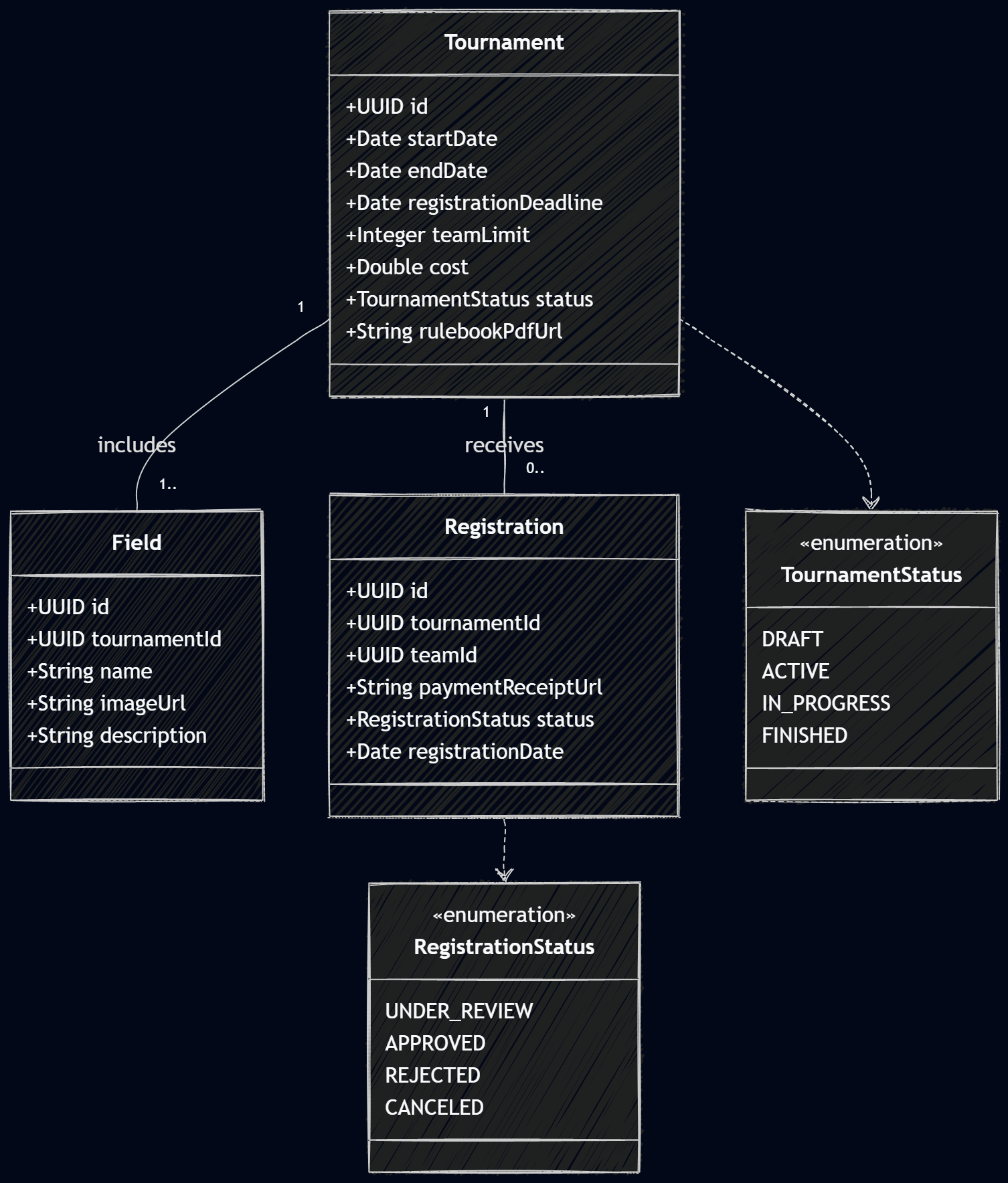
The class diagram used for the models is the following:
The entity-relation diagram used for JPA is the following:
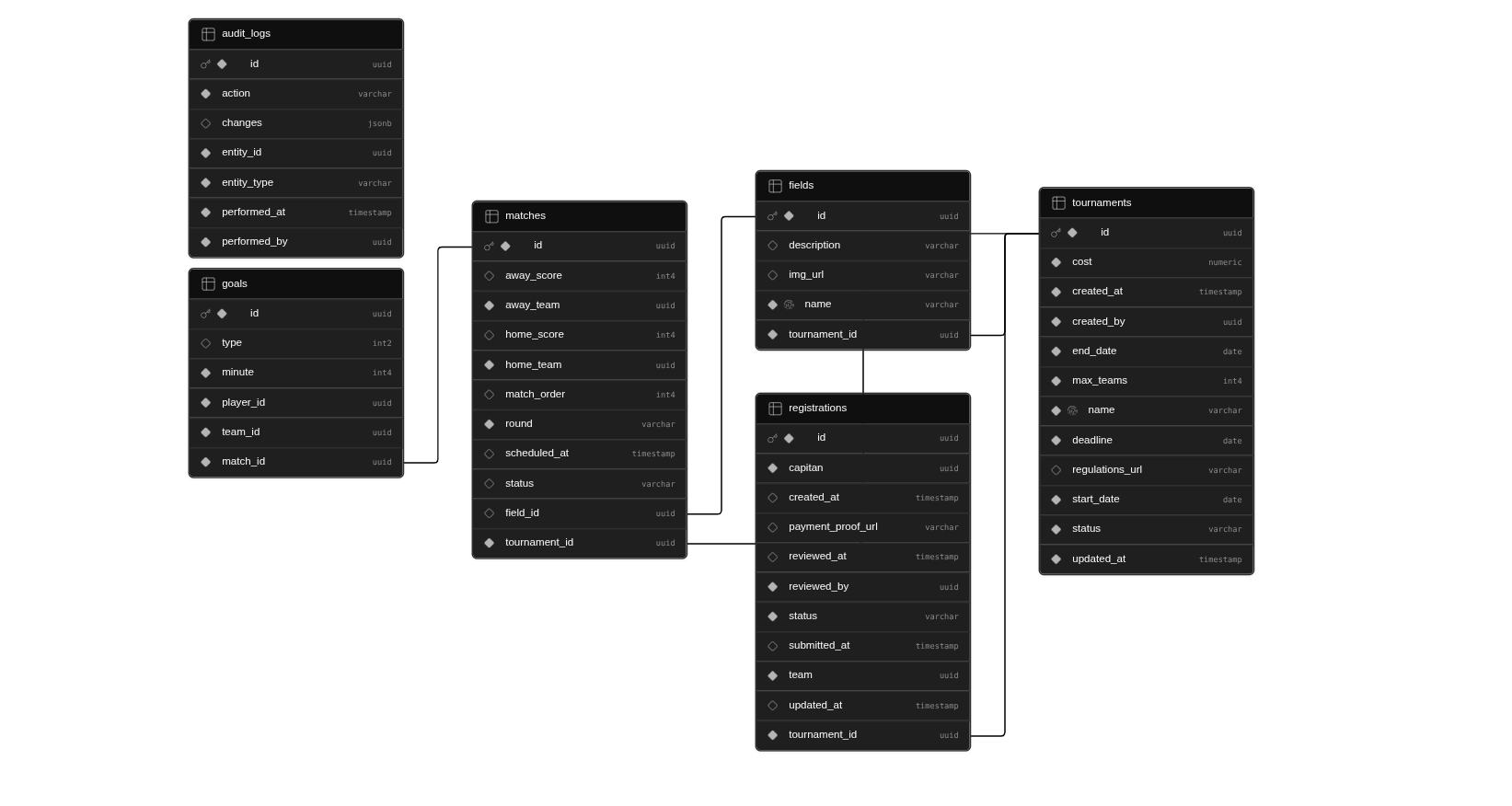
The entities defined for this service are:
tournaments
Stores the general configuration and lifecycle state of each tournament.
| Column | Type | Notes |
|---|---|---|
id |
UUID PK |
Auto-generated |
name |
VARCHAR(100) |
Unique tournament name |
start_date |
DATE |
Must be today or in the future |
end_date |
DATE |
Must be after start date |
registration_close_date |
DATE |
Must be on or before start date |
max_teams |
INTEGER |
Between 2 and 32 |
cost |
DECIMAL |
Non-negative |
status |
ENUM |
DRAFT · ACTIVE · IN_PROGRESS · FINISHED |
regulations_url |
VARCHAR |
Optional URL to the PDF rulebook |
created_by |
UUID |
Cross-service reference to the organizer in Identity Service |
created_at |
TIMESTAMP |
Set automatically on creation |
updated_at |
TIMESTAMP |
Updated automatically on every change |
registrations
Tracks team registration requests and their payment verification status.
| Column | Type | Notes |
|---|---|---|
id |
UUID PK |
Auto-generated |
tournament_id |
UUID FK |
References tournaments.id |
team_id |
BIGINT |
Cross-service reference to Teams Service |
captain_id |
BIGINT |
Cross-service reference to Identity Service |
payment_proof_url |
VARCHAR |
URL of the uploaded payment receipt |
status |
ENUM |
UNDER_REVIEW · APPROVED · REJECTED · CANCELLED |
submitted_at |
TIMESTAMP |
When the captain submitted the registration |
reviewed_at |
TIMESTAMP |
When the organizer reviewed it |
reviewed_by |
BIGINT |
Organizer’s cross-service reference |
created_at |
TIMESTAMP |
Set automatically on creation |
updated_at |
TIMESTAMP |
Updated automatically on every change |
matches
Stores each match generated for a tournament, including scheduling and results.
| Column | Type | Notes |
|---|---|---|
id |
UUID PK |
Auto-generated |
tournament_id |
UUID FK |
References tournaments.id |
round |
ENUM |
GROUP · QUARTER_FINAL · SEMI_FINAL · FINAL |
match_order |
INTEGER |
Position within the round |
home_team_id |
UUID |
Cross-service reference to Teams Service |
away_team_id |
UUID |
Cross-service reference to Teams Service |
home_score |
INTEGER |
Null until result is registered |
away_score |
INTEGER |
Null until result is registered |
scheduled_at |
TIMESTAMP |
Scheduled date and time |
status |
ENUM |
SCHEDULED · IN_PROGRESS · FINISHED · CANCELLED |
goals
Records each goal scored during a match, linked to the player who scored it.
| Column | Type | Notes |
|---|---|---|
id |
UUID PK |
Auto-generated |
match_id |
UUID FK |
References matches.id |
player_id |
UUID |
Cross-service reference to Users & Players Service |
team_id |
UUID |
Cross-service reference to Teams Service |
minute |
INTEGER |
Minute of the match when the goal was scored |
fields
Stores the available fields (canchas) where matches can be played.
| Column | Type | Notes |
|---|---|---|
id |
UUID PK |
Auto-generated |
tournament_id |
UUID FK |
References tournaments.id |
name |
VARCHAR |
Field name |
description |
VARCHAR |
Optional description |
image_url |
VARCHAR |
URL to the field image stored in MongoDB |
audit_logs
Append-only log of all relevant actions performed on tournaments and registrations.
| Column | Type | Notes |
|---|---|---|
id |
UUID PK |
Auto-generated |
entity_type |
ENUM |
TOURNAMENT · REGISTRATION |
entity_id |
UUID |
ID of the affected entity |
action |
VARCHAR |
CREATED · STATUS_CHANGED · UPDATED · DELETED |
performed_by |
BIGINT |
Cross-service reference to the user who performed the action |
previous_status |
VARCHAR |
Status before the change (if applicable) |
new_status |
VARCHAR |
Status after the change (if applicable) |
details |
JSON |
Additional context about the action |
timestamp |
TIMESTAMP |
Defaults to NOW() |
Cross-service references (team IDs, user IDs, captain IDs) are stored as primitive types (
UUID,BIGINT) since the Tournament Service does not own those entities. The actual data lives in the Teams Service, Identity Service, or Users & Players Service respectively.
Endpoints
Tournament lifecycle
| Method | Path | Auth required | Description |
|---|---|---|---|
POST |
/api/v1/tournaments |
Bearer (ORGANIZER) |
Creates a tournament in DRAFT state. |
GET |
/api/v1/tournaments |
No | Returns all tournaments. |
GET |
/api/v1/tournaments/{id} |
No | Returns a tournament by ID. |
PATCH |
/api/v1/tournaments/{id}/activate |
Bearer (ORGANIZER) |
Transitions state from DRAFT to ACTIVE. |
PATCH |
/api/v1/tournaments/{id}/start |
Bearer (ORGANIZER) |
Transitions state from ACTIVE to IN_PROGRESS. Start date must equal today. |
PATCH |
/api/v1/tournaments/{id}/finish |
Bearer (ORGANIZER) |
Transitions state from IN_PROGRESS to FINISHED. End date must be today or earlier. |
DELETE |
/api/v1/tournaments/{id} |
Bearer (ORGANIZER) |
Deletes a tournament. Only allowed in DRAFT state. |
Registrations
| Method | Path | Auth required | Description |
|---|---|---|---|
POST |
/api/v1/tournaments/{id}/registrations |
Bearer (CAPTAIN) |
Registers a team in a tournament and uploads payment proof. |
GET |
/api/v1/tournaments/{id}/registrations |
Bearer (ORGANIZER) |
Lists all registrations for a tournament. |
GET |
/api/v1/tournaments/{id}/registrations/{regId} |
Bearer | Returns a single registration. |
PATCH |
/api/v1/tournaments/{id}/registrations/{regId}/approve |
Bearer (ORGANIZER) |
Approves a registration. |
PATCH |
/api/v1/tournaments/{id}/registrations/{regId}/reject |
Bearer (ORGANIZER) |
Rejects a registration. |
PATCH |
/api/v1/tournaments/{id}/registrations/{regId}/cancel |
Bearer (CAPTAIN) |
Cancels a registration. Only allowed while UNDER_REVIEW. |
Statistics
| Method | Path | Auth required | Description |
|---|---|---|---|
GET |
/api/tournaments/{id}/stats/top-scorers |
No | Returns the top scorers for a tournament. |
GET |
/api/tournaments/{id}/stats/matches |
No | Returns the full match history for a tournament. |
GET |
/api/tournaments/{id}/stats/teams/{teamId} |
No | Returns stats for a specific team in a tournament. |
Inter-service communication
This service communicates directly with other microservices using OpenFeign — not through the API Gateway. This is intentional: inter-service calls are internal and should not pass through the public entry point.
| Called service | When | Purpose |
|---|---|---|
| Teams Service | On team registration | Verify the team exists before creating the registration |
| Identity Service | On state transitions | Validate the requesting user has the ORGANIZER role |
The gateway injects X-User-Id, X-User-Role, and X-User-Email headers into every forwarded request. The service reads X-User-Id to identify the organizer or captain performing each action.
Tournament state machine
DRAFT ──► ACTIVE ──► IN_PROGRESS ──► FINISHED
  │
  └──► (deleted)
| Transition | Condition |
|---|---|
DRAFT → ACTIVE |
No additional condition required |
ACTIVE → IN_PROGRESS |
startDate == today |
IN_PROGRESS → FINISHED |
endDate <= today |
DRAFT → deleted |
Tournament must still be in DRAFT |
Registration state machine
UNDER_REVIEW ──► APPROVED
     │
     └──► REJECTED
     │
     └──► CANCELLED  (captain only, before review)