This section explains how the Identity Service and the API Gateway (Orchestrator) were built and how they work together to secure the TechCup platform.
Container diagram
The following diagram shows the containers that make up both services and their relationships with the rest of the microservices and the frontend.
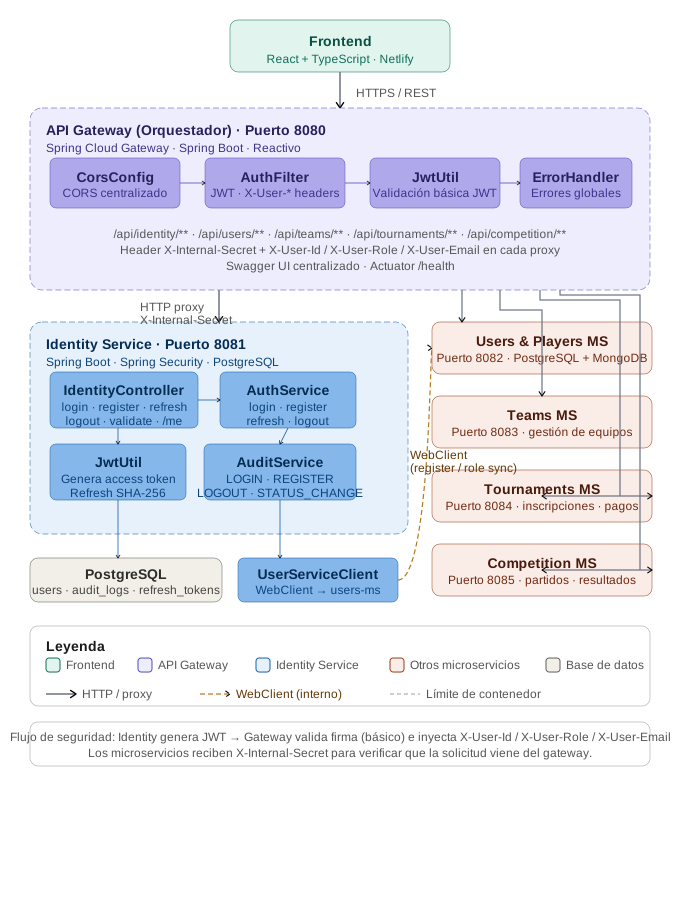
Identity Service
Dependencies
Parent
- spring-boot-starter-parent – Base Spring Boot POM (v3.4.5). Manages dependency versions and build defaults.
Runtime dependencies
- spring-boot-starter-web – Enables REST APIs via Spring MVC with an embedded Tomcat server.
- spring-boot-starter-data-jpa – Maps Java entities to database tables and provides repository interfaces for CRUD operations.
- spring-boot-starter-security – Integrates Spring Security for authentication and authorization.
- spring-boot-starter-validation – Enables bean validation (
@Valid,@NotBlank, etc.) on request bodies. - spring-boot-starter-webflux – Provides the reactive
WebClientused to call the Users & Players microservice. - postgresql – JDBC driver that connects the service to its own PostgreSQL database at runtime.
- jjwt-api / jjwt-impl / jjwt-jackson (v0.12.6) – JJWT library for generating and validating JWT access tokens and hashing refresh tokens with SHA-256.
- springdoc-openapi-starter-webmvc-ui (v2.8.6) – Generates and serves a Swagger UI at
/api/identity/swagger-ui.html.
Test dependencies
- spring-boot-starter-test – Provides JUnit 5, Mockito, and AssertJ.
- spring-security-test – Helpers for testing secured endpoints.
- h2 – In-memory database used only during tests.
Build plugins
- spring-boot-maven-plugin – Packages the service as a runnable fat JAR (
java -jar techcup-identity-service.jar). - jacoco-maven-plugin (v0.8.11) – Generates code-coverage reports in XML format for SonarQube integration.
Diagrams & JPA
The entities managed by this service are:
users
Stores authentication credentials and the system role. The users_ms_user_id column links each record to its extended profile in the Users & Players microservice.
| Column | Type | Notes |
|---|---|---|
id |
BIGINT PK |
Auto-generated |
email |
VARCHAR UNIQUE |
Used as login identifier |
password |
VARCHAR |
BCrypt-hashed |
role |
ENUM |
INVITED · PLAYER · CAPTAIN · ORGANIZER · REFEREE · ADMIN |
status |
ENUM |
ACTIVE · INACTIVE |
users_ms_user_id |
BIGINT |
Cross-service link to users-ms |
refresh_tokens
Stores token rotation records. The raw UUID token is never persisted — only its SHA-256 hash.
| Column | Type | Notes |
|---|---|---|
id |
BIGINT PK |
Auto-generated |
token_hash |
VARCHAR(64) |
SHA-256 of the raw UUID sent to the client |
user_id |
BIGINT FK |
References users.id |
users_ms_user_id |
BIGINT |
Cross-service link |
created_at |
TIMESTAMP |
Creation time |
expires_at |
TIMESTAMP |
created_at + 7 days |
revoked |
BOOLEAN |
Set to true on logout or rotation |
audit_logs
Append-only log of security-relevant actions.
| Column | Type | Notes |
|---|---|---|
id |
BIGINT PK |
Auto-generated |
action |
VARCHAR |
LOGIN · LOGOUT · REGISTER · STATUS_CHANGE |
user_email |
VARCHAR |
Email of the actor |
details |
VARCHAR |
Human-readable description |
ip_address |
VARCHAR |
Remote IP of the request |
timestamp |
TIMESTAMP |
Defaults to NOW() |
Endpoints
| Method | Path | Auth required | Description |
|---|---|---|---|
POST |
/api/identity/register |
No | Creates credentials in identity-ms and full profile in users-ms. Returns access token + sets refresh cookie. |
POST |
/api/identity/login |
No | Validates credentials. Returns access token + sets refresh_token httpOnly cookie. |
POST |
/api/identity/refresh |
Cookie | Rotates the refresh token and issues a new access token. |
POST |
/api/identity/logout |
Bearer | Revokes all refresh tokens for the user and clears the cookie. |
GET |
/api/identity/validate |
Bearer | Validates the access token and returns user info. |
GET |
/api/identity/me |
Bearer | Alias of /validate. Returns the current user’s profile. |
GET |
/api/identity/users |
Bearer (ADMIN) | Lists all users in the system. |
PATCH |
/api/identity/users/{id}/role |
Bearer | Updates a user’s role. Self-promotion: INVITED→PLAYER or PLAYER→CAPTAIN. ADMIN can set any role. |
PATCH |
/api/identity/users/{id}/status |
Bearer (ADMIN) | Activates or inactivates a user. Blocked if the user is enrolled in an active tournament. |
Security design
- Access token – JWT signed with HMAC-SHA256. Claims:
sub= userId,email,role,name. Expiration configurable viajwt.expiration(default 15 min). - Refresh token – Random UUID sent to the client as an
httpOnlycookie. Only the SHA-256 hash is stored in the database. Each use triggers token rotation (old token revoked, new one issued). - Password storage – BCrypt via
PasswordEncoder. - Internal requests – The gateway adds
X-Internal-Secretto every proxied request. The service can verify the header to reject direct external calls.
API Gateway
Dependencies
Parent
- spring-boot-starter-parent – Base Spring Boot POM (v3.4.5).
Runtime dependencies
- spring-cloud-starter-gateway – Core Spring Cloud Gateway library. Provides reactive routing, predicate matching, and the filter chain used to proxy requests to each microservice.
- spring-boot-starter-security – Adds the reactive security context required by the gateway filter chain.
- jjwt-api / jjwt-impl / jjwt-jackson (v0.12.3) – Used by
AuthFilterandJwtUtilto validate the JWT signature and expiration before forwarding requests. - lombok – Generates boilerplate at compile time (excluded from the final JAR).
- spring-boot-starter-actuator – Exposes
/actuator/healthand/actuator/infofor monitoring. - springdoc-openapi-starter-webflux-ui (v2.8.4) – Aggregates Swagger docs from all microservices into a single UI at
/swagger-ui.html.
Test dependencies
- spring-boot-starter-test – Provides JUnit 5 and Mockito for unit testing filters.
Dependency management
- spring-cloud-dependencies BOM (v2024.0.1) – Ensures all Spring Cloud libraries use compatible versions.
Build plugin
- spring-boot-maven-plugin – Packages the gateway as a runnable fat JAR. Lombok is excluded from the final artifact.
Routing table
| Route id | Path pattern | Auth filter | Upstream service |
|---|---|---|---|
identity-public |
POST /api/identity/login, /register, /refresh |
No | Identity Service (:8081) |
identity-protected |
/api/identity/** |
Yes | Identity Service (:8081) |
users-register |
POST /api/users/register |
No | Users & Players MS (:8082) |
users-service |
/api/users/** |
Yes | Users & Players MS (:8082) |
teams-service |
/api/teams/** |
Yes | Teams MS (:8083) |
tournaments-service |
/api/tournaments/** |
Yes | Tournaments MS (:8084) |
competition-service |
/api/competition/** |
Yes | Competition MS (:8085) |
Every proxied request receives the X-Internal-Secret header so downstream services can reject calls that bypass the gateway.
Security design
The gateway is the single entry point for all external traffic. Its security responsibility is different from the identity service’s:
| Concern | Identity Service | API Gateway |
|---|---|---|
| Login / token generation | ✅ | ❌ |
| JWT generation | ✅ | ❌ |
| JWT full validation | ✅ | ✅ basic (signature + expiration) |
| Roles & permissions logic | ✅ | ❌ |
| Block requests without token | ❌ | ✅ |
| CORS | ❌ | ✅ single source of truth |
| Propagate user context | ❌ | ✅ via X-User-Id, X-User-Role, X-User-Email |
The AuthFilter validates the Bearer token on every protected route, extracts userId, role, and email from the JWT claims, and injects them as request headers before forwarding. Microservices trust these headers instead of re-validating the token themselves.